





Why the Early Years Are the Most Important Years of Learning

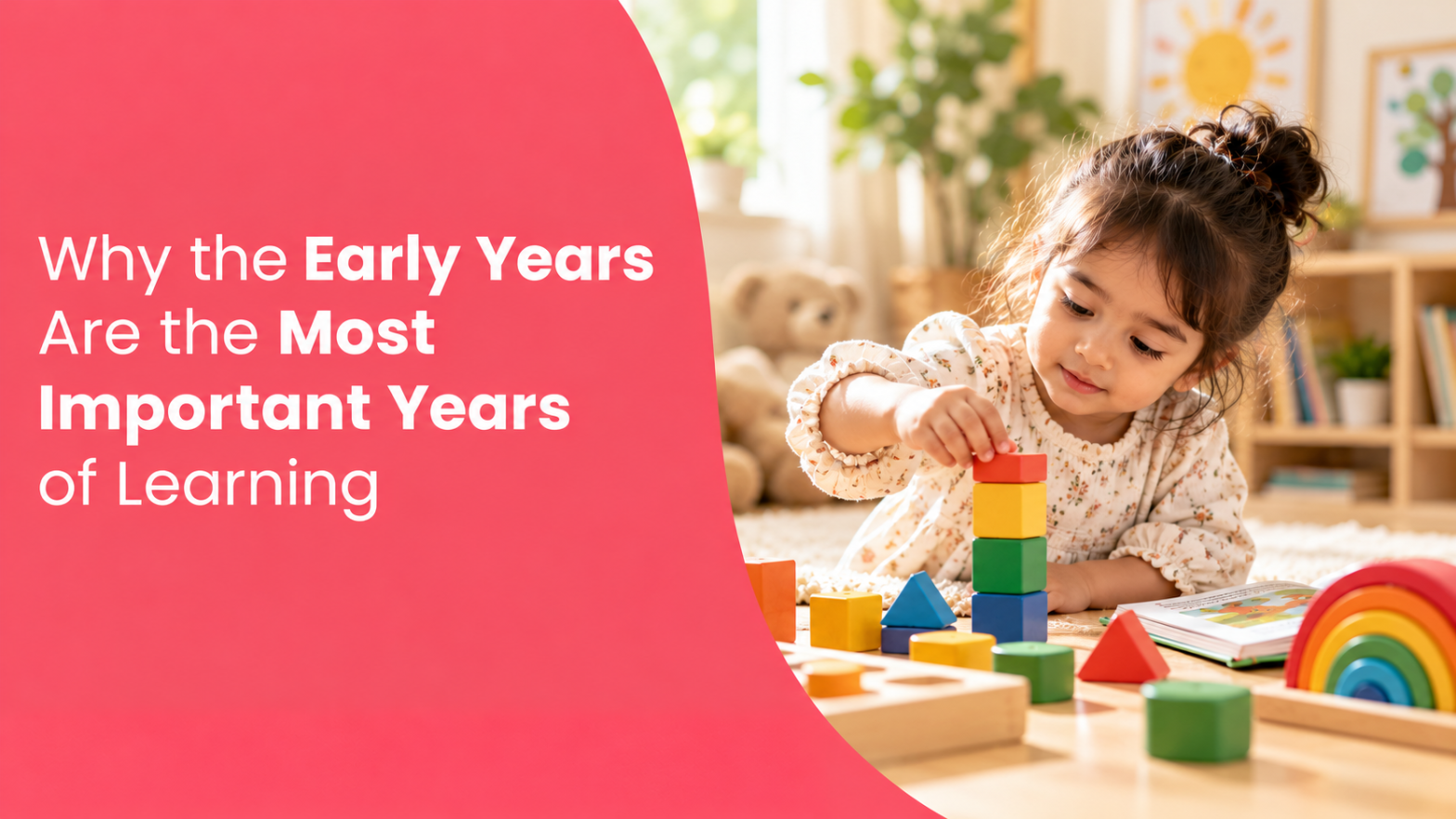
Think back to the last time your toddler surprised you. Maybe she used a word you didn’t know she had heard. Maybe he finally fitted the round block into the round hole after twenty tries, then looked up at you, beaming. Moments like these feel small and ordinary. In truth, they are some of the most important learning your child will ever do.
Many parents assume that “real” learning begins in Class 1, when there are textbooks, homework and report cards. The science tells a very different story. The years between one and six are when the brain grows faster than it ever will again. This is when the habits, skills, and feelings that shape the rest of a child’s life quietly take root.
Hence, if you’re searching for the best preschool in Gurgaon for your little one, it will help if you already understand why these years matter so much. In this blog post, we’ve covered what happens in a young child’s brain, which foundational skills develop during this time, why emotional growth deserves as much attention as the alphabet, and how you can make the most of these years at home and at school.
What Happens in the Brain Before Age Six
A newborn’s brain is not a smaller version of an adult’s. It is a work in progress, and it is built through experience.
According to UNICEF, more than 1 million new neural connections are formed every second in the first few years of life. The brain doubles in size in the first year, reaches about 80% of its adult size by age three, and is nearly full-grown, at around 90%, by age five. India’s National Education Policy 2020 makes the same point, noting that over 85% of a child’s cumulative brain development occurs before the age of six.
Connections That Are Used Get Stronger
The brain builds far more connections than it needs. Over time, the ones that are used often grow stronger, while the ones that aren’t used fade away. This is why everyday experiences, such as being spoken to, sung to, read to, and played with, matter so much. Each one strengthens a pathway that the child will rely on later.
Relationships Are the Building Blocks
Children don’t learn in isolation. Researchers at the Harvard Centre on the Developing Child call the back-and-forth between a child and a caring adult, such as a babble answered with a smile or a pointed finger answered with a name, “serve and return”. They describe these everyday exchanges as playing a key role in shaping the brain’s architecture. In other words, warm, responsive relationships are not a nice extra. They are the foundation on which all other learning sits.
The Foundational Skills That Take Shape Between One and Six
The early years are not about cramming in facts. They are about building the skills that make all future learning possible.
Language and Communication
Between one and six, most children go from a handful of words to full sentences, stories, and endless questions. The more conversations a child hears and takes part in, the richer their vocabulary becomes, and a strong vocabulary makes reading far easier later on.
Thinking and Problem-Solving
Every time a child figures out why a tower keeps falling or how to fit a lid on a box, they are practising reasoning, memory and cause and effect. These are the same skills they will later use for maths and science.
Attention and Self-Control
Waiting for a turn, following a two-step instruction or stopping a game when it’s time to tidy up may look simple. In fact, they draw on what scientists call executive function, a set of skills that help us plan, focus, remember and manage our impulses. Children aren’t born with these skills, but they are born with the ability to develop them, and the early years are when they first begin to take shape.
Movement and Coordination
Running, climbing, jumping and balancing build large muscles, while threading beads, holding a crayon and buttoning a shirt build the small muscles of the hand. A child who has had plenty of practice with both often finds writing much easier when the time comes.
Emotional Growth Matters Just as Much
It’s natural to focus on milestones we can count, such as letters, numbers and colours. But how a child feels shapes how well they learn.
In the early years, children are learning to recognise their feelings, put them into words and calm themselves down after a big upset. They are learning that adults can be trusted, that mistakes are not the end of the world, and that other people have feelings, too.
A child who feels safe and loved is more willing to explore, try new things and keep going when something is hard. A child who is anxious or constantly stressed has far less energy left for learning. This is why patient teachers, predictable routines and a warm classroom matter so much at this age.
Why These Years Can’t Simply Be Made Up Later
The brain stays able to learn throughout life, which is good news for all of us. But it is most adaptable in the early years. Building strong foundations now is far easier than repairing weak ones later.
Think of it like building a house. A solid foundation doesn’t get much attention once the walls are up, yet everything above it depends on it. The early years are that foundation, for learning, for relationships and for health.
What This Means for Parents
You don’t need expensive toys or flashcards to support your child’s development. Small, everyday moments do most of the work.
- Talk with your child, not just to them, and give them time to reply
- Read together every day, even if it’s the same book for the tenth time
- Let them play, freely and often, indoors and outdoors
- Name feelings when you see them, such as “You look frustrated. That puzzle is tricky.”
- Keep routines predictable, so your child knows what comes next
- Limit screen time, and choose real conversations and play wherever you can
What to Look For in an Early Years Programme
When you visit a preschool, look past the colourful walls and ask how the day is spent. A good early years programme gives children plenty of time to play, explore and talk. Teachers get down to a child’s eye level, ask open questions and give children time to try things for themselves. The classroom feels calm and busy rather than silent or chaotic.
If you’d like to go deeper, our guide to finding the best preschools in Gurgaon covers what to look for in detail, and our article on what children truly learn in preschool explains the skills that matter beyond ABCs and numbers.
How We Nurture the Early Years at Fuji Infinity
At Fuji Infinity International Preschool, located on CRPF Road, Sector 62, Gurugram, our programmes are designed for exactly these years, from our Parent Toddler programme for children as young as 12 months to Kindergarten for children aged five to six.
We follow the IB PYP early years framework and bring together the thoughtful traditions of Japanese early education with ideas from Reggio Emilia, Multiple Intelligence Theory and Maria Montessori. Our framework, The Fuji Way, rests on four pillars: Love, Nurture, Play and Prepare. Each pillar reflects what children need most in their early years: a sense of being loved, adults who care for them patiently, plenty of time to play, and the gentle preparation that helps them move confidently to big school.
Our 1.2-acre campus includes a greenhouse, an Explorium, a gymnasium, a music studio, a pottery zone, a Lego wall and a story zone, giving children countless ways to move, create, wonder and ask questions.
Frequently Asked Questions (FAQs)
1. Why are the first six years so important for learning?
This is when the brain grows fastest. Over 85% of a child’s brain development takes place before the age of six, so the experiences children have during these years shape how they think, communicate, and relate to others.
2. Should my child be reading and writing before Class 1?
Not necessarily. At this age, a love of stories, a rich vocabulary and strong hand muscles matter more than formal reading and writing. These foundations make reading and writing much easier later.
3. Is it too early to start preschool at two?
Not if the programme is play-based, gentle and suited to your child’s age. What matters most is that your child feels safe and cared for.
4. How can I support my child’s brain development at home?
Talk, read, sing and play together every day. Responsive, loving interactions do more for a young child’s brain than any app or worksheet.
To Sum Up
The early years go by in a blur of first words, scraped knees, and bedtime stories. But underneath it all, something remarkable is happening. Your child’s brain is building the foundations for every kind of learning that will follow. If you’re looking for the best preschool in Gurgaon to make the most of these precious years, we’d love to show you how we do it at Fuji Infinity International Preschool, Sector 62, Gurgaon. To book a campus visit, call us on +91 81308 99188, or write to info@fujiinfinity.in.