





How Safe Is Your Child’s Preschool? A Simple Safety Checklist for Parents

The first time you leave your child at preschool, you’ll probably spend the morning glancing at your phone. Is she okay? Did he eat his lunch? What if she falls?
That worry is completely natural. You’re handing over the most precious person in your life to people you’ve only just met. And while every school promises that children are safe, it’s the details that really show how seriously a school takes it.
Most preschools in Gurgaon will point out their CCTV cameras during a campus tour. But safety goes far beyond cameras. In this blog post, we’ve put together a practical checklist covering the gate, the campus, the staff, health, food, transport, and emotional wellbeing, so you know exactly what to ask. For the bigger picture on choosing a school, read our guide to finding the best preschool in Gurgaon .
Safety at the Gate
Who Can Walk In?
Notice what happens when you arrive. Were you asked who you are and why you’re there? Is there a visitor register, a guard at the gate or a secured entry system? A school that lets you wander in unchecked will probably let others do the same.
Who Can Take Your Child Home?
Ask what happens if an unfamiliar adult turns up to collect a child. The answer should be firm: no one leaves with a child unless the school has been informed in advance and can verify who they are. Add every adult who might ever do the pick-up, including grandparents, a nanny or a driver, when you fill in the admission form.
The Campus Itself
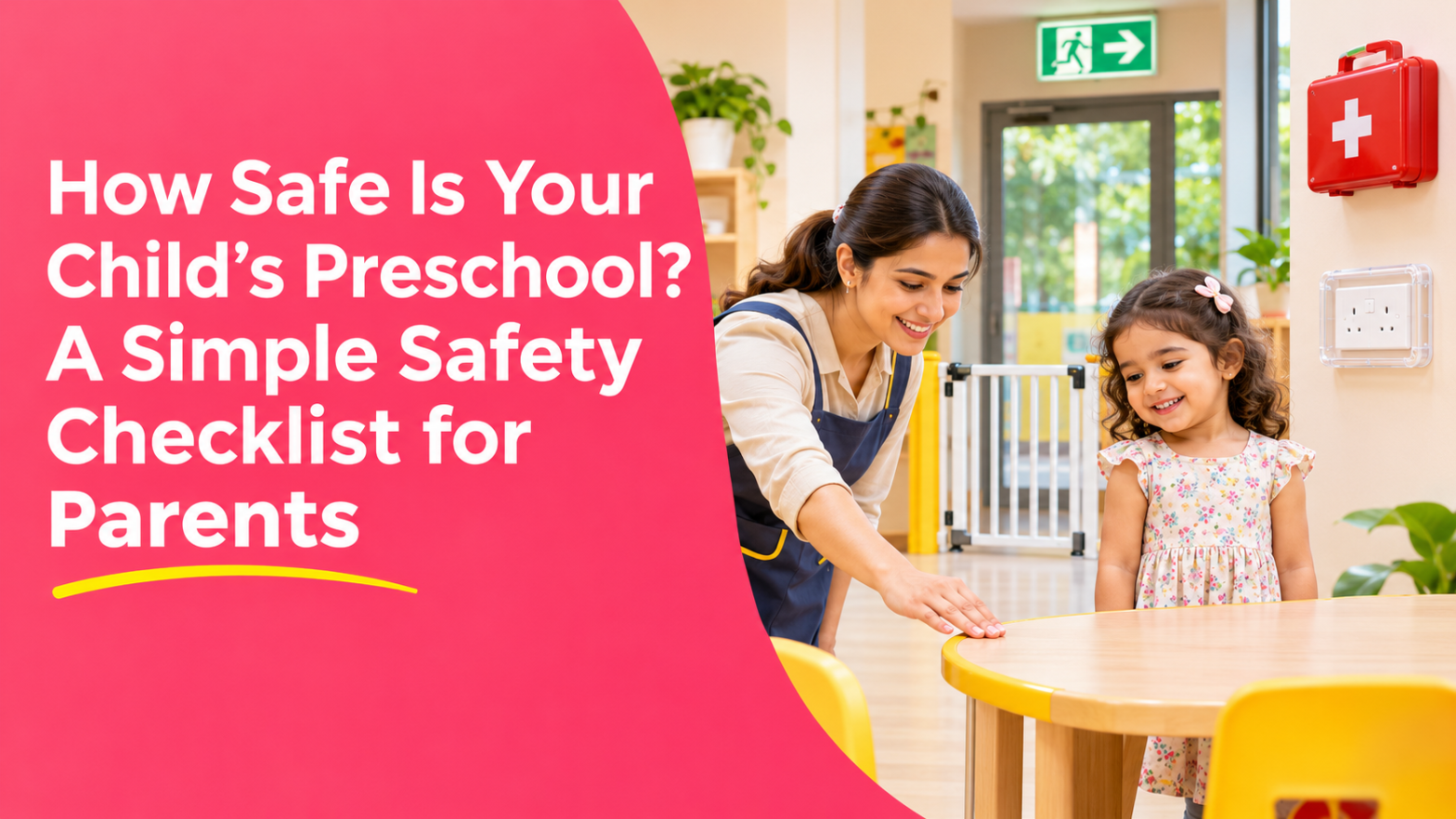
Get down to your child’s height and look around. Are sharp corners covered? Are electrical sockets out of reach? Are toys non-toxic and in good condition? Is the outdoor area fenced? Are the washrooms clean and child-sized, with an adult always close by?
CCTV is useful, but it isn’t the whole story. The NCPCR’s Manual on Safety and Security of Children in Schools points out that CCTV in schools needs to be monitored and maintained regularly. So, ask who watches the footage, how long it’s stored and who is allowed to see it.
Some schools offer parents a live feed, while others don’t, in order to protect the privacy of every child in the class. Both approaches can work. What matters is that the school has a clear policy and is happy to explain it.
The People Caring for Your Child
Teachers, helpers, drivers and security staff all spend time around children. Ask whether every one of them has been background-checked before joining.
It’s also worth asking about training. Staff should know first aid, what to do in an emergency, and how to recognise signs that a child may be at risk. In India, the Protection of Children from Sexual Offences (POCSO) Act, 2012, protects children from sexual abuse, and a good school will make sure all its staff understand it.
Finally, ask how children are supervised during toilet breaks, naps and outdoor play, since these are the moments when supervision matters most.
Health and First Aid
- Trained first-aiders on every floor or in every section
- A nurse on campus, or a clear plan for medical help
- A tie-up with a nearby hospital for emergencies
- A written medicines policy, so nothing is given without your consent
- A clear sickness policy about when children should stay home
- Daily cleaning routines for toys, tables and washrooms
Food and Allergies
If the school serves meals, ask to see where the food is cooked. Check how allergies are recorded and how the kitchen and the teachers make sure an allergic child never gets the wrong plate. For younger children, also ask how food is cut and served, since small, round foods like whole grapes can be a choking hazard.
School Transport
If your child will use the school van or bus, transport deserves its own set of questions. The NCPCR manual covers bus safety in detail and recommends police verification of bus staff before they are appointed.
Ask whether there’s a trained attendant on every ride, whether vehicles can be tracked, how children are seated, and how the handover works at your stop. Find out, too, what happens if no one is at the stop to receive your child.
Emotional Safety
A child can be physically safe and still feel unsafe. Ask how teachers respond to tears, tantrums, biting and a child who is being left out. Is there a quiet corner where an overwhelmed child can calm down? Are children ever shouted at or shamed?
Children who feel emotionally safe are more likely to tell an adult when something is wrong, which is one of the best protections of all.
Your Preschool Safety Checklist at a Glance
| Area | What to ask |
| Entry and exit | How are visitors checked? Who can collect my child? |
| Campus | Are corners, sockets, stairs, and play areas child-safe? |
| CCTV | Who monitors the footage, and what is the parent access policy? |
| Staff | Are all staff background-checked and trained in first aid and child protection? |
| Health | Is there a nurse on campus? What is the emergency plan? |
| Food | Where is food cooked? How are allergies managed? |
| Transport | Is there an attendant on every ride? Can the vehicle be tracked? |
| Emotional safety | How do teachers handle tears, conflict and children who feel left out? |
What Parents Can Do at Home
A school’s safety measures work best when children know a few simple things, too. Teach your child their full name and a parent’s name. Use the correct words for body parts, and explain, in a calm and simple way, that no one should touch the parts covered by their swimsuit. Most importantly, let them know they can always tell you anything, and that they will never be in trouble for it.
How We Keep Children Safe at Fuji Infinity
At Fuji Infinity International Preschool, Sector 62, safety is built into every part of the day. Our campus has 24/7 CCTV, biometric-secured entry, non-toxic and eco-friendly toys, rounded edges on furniture, and frequent sanitisation routines. Our staff are trained in first aid and emergency procedures, and every staff member completes mandatory POCSO and child safety training.
Trained nurses are on campus, and we arrange yearly medical check-ups through our partner hospitals, paediatricians and dentists. In an emergency, parents are informed immediately, and children are taken to a partner facility if needed. Allergy and dietary details shared by parents are followed strictly by our kitchen and staff.
We keep CCTV recordings to protect the safety and privacy of every child, rather than offering a live feed. If a parent has a concern, they can request a meeting with our Principal. Our school transport has a nanny on board, and parents receive tracking links. And because emotional safety matters just as much, our staff are trained in empathy and child psychology, and we have calming zones where children can take a quiet moment.
Frequently Asked Questions
1. Should a preschool give parents live CCTV access?
Not necessarily. Some schools do, while others keep recordings private to protect every child in the class. What matters is a clear policy and a simple way for parents to raise concerns.
2. What safety training should preschool staff have?
At the very least, first aid, emergency procedures and child protection, including awareness of the POCSO Act.
3. How can I check if a preschool is truly safe?
Visit during school hours, use a checklist, ask direct questions, and speak to parents whose children already attend the school.
4. What should I do if I have a safety concern?
Raise it with the teacher or principal straight away, in writing if needed. A good school will take it seriously and respond quickly.
To Sum Up
Safety isn’t a single feature on a brochure. It’s the gate, the people, the routines, and the culture of a school, all working together. The more specific your questions, the clearer the picture you’ll get.
As you visit preschools in Gurgaon, choose the one that answers your safety questions clearly and without hesitation. At Fuji Infinity International Preschool, Sector 62, safety is built into every part of the day, from biometric-secured entry and trained nurses on campus to staff who complete mandatory POCSO and child safety training. We’d be glad to walk you through every measure we take. Book a campus visit or call us on +91 81308 99188, and see for yourself how we look after every child.