





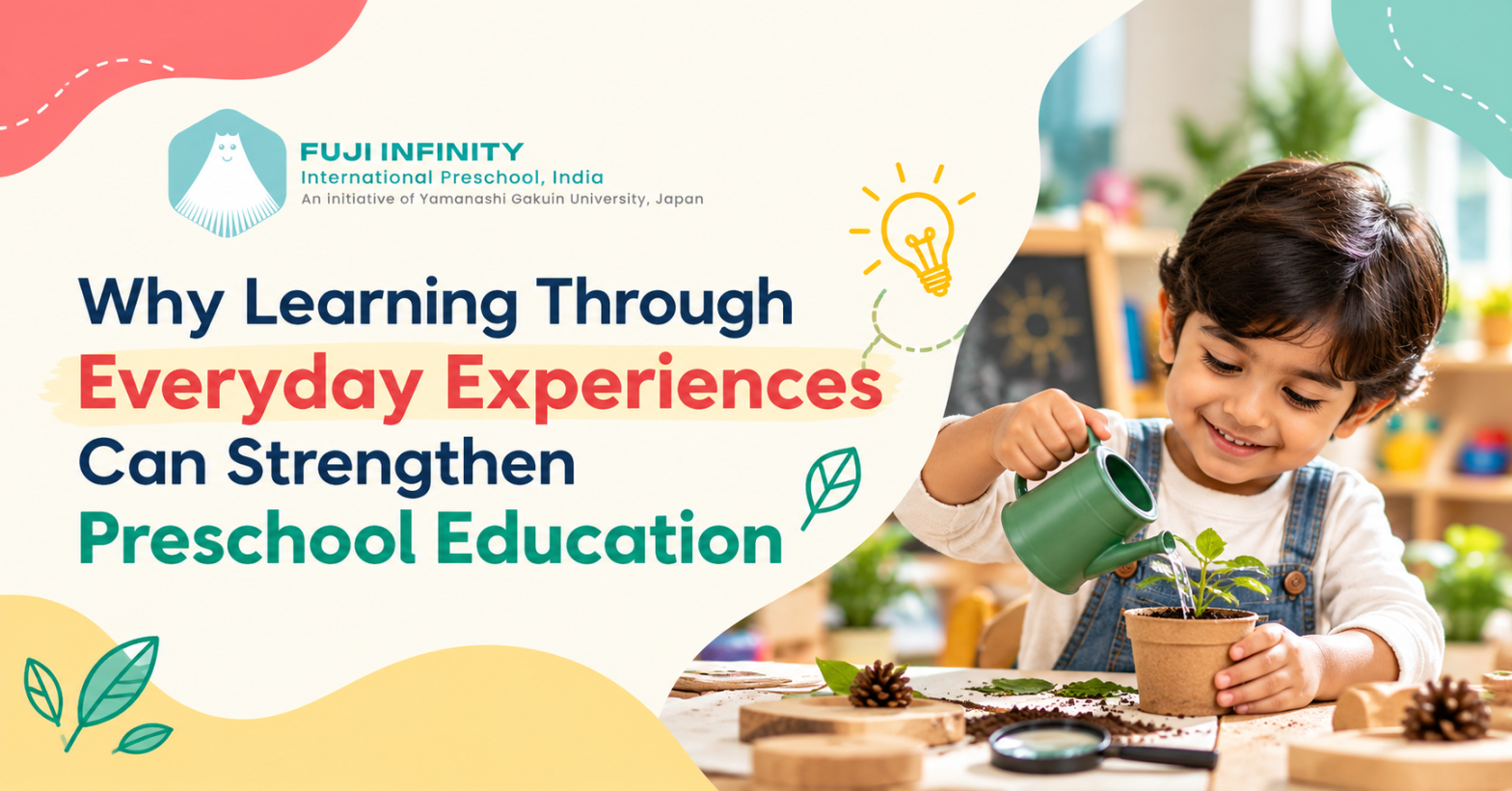
Why Learning Through Everyday Experiences Can Strengthen Preschool Education

Key Highlights
- Everyday experiences can turn ordinary moments into meaningful learning opportunities.
- Hands-on activities help children connect ideas with real life.
- Play, routines, nature and social interactions can support holistic development.
- Inquiry-based learning encourages children to ask questions and explore possibilities.
- Small responsibilities can build confidence, independence and self-management.
- A nurturing environment allows children to learn at their own pace.
Introduction
A child does not need a textbook to begin learning. Watching a butterfly, arranging toys, helping a friend, watering a plant, listening to a story or asking why something happens can all become valuable learning experiences.
For families exploring the Top 10 Pre Schools in Gurgaon, the learning environment deserves attention beyond classrooms and academic activities. At FUJI Infinity International Preschool, Gurgaon, a strong preschool experience can help children discover that learning is not limited to a particular time or place. Instead, it can happen through play, conversations, relationships, routines and exploration.
Why Are Everyday Experiences Important in Preschool?
Young children understand ideas more easily when they can connect them with something familiar. Counting objects, for example, becomes more meaningful when children count their building blocks or toys. Learning about plants becomes more engaging when they actually observe leaves, soil and growing seeds.
Everyday experiences create these connections naturally.
They also allow children to learn at different levels. One child may focus on colours while another notices shapes, movement or patterns. Educators can observe these interests and extend learning through questions and activities.
How Does Hands-On Learning Make Concepts Meaningful?
Children are active learners. They often understand something better when they can experience it instead of simply hearing an explanation.
A simple activity such as mixing colours can introduce ideas related to observation and cause-and-effect. Building with blocks can encourage children to think about balance, size and structure. Sorting everyday objects can introduce early mathematical thinking.
Hands-on learning can also make room for mistakes.
If a block tower falls, children can try another arrangement. If a drawing does not look as expected, they can experiment with different materials. These moments encourage persistence and help children understand that learning involves trying, adjusting and trying again.
Can Daily Routines Become Learning Opportunities?
Some of the most valuable learning moments can happen during ordinary routines.
Putting belongings away can encourage organisation. Waiting for a turn can introduce patience. Cleaning up after an activity can develop responsibility. Choosing between two activities can encourage decision-making.
These routines may appear simple, but repeated experiences can gradually strengthen self-management and independence.
How Does Nature Encourage Curiosity?
Nature provides an open-ended learning environment. Children can observe changing weather, growing plants, insects, leaves, shadows and different textures.
A simple question such as “Why is the shadow moving?” can lead to observation, discussion and experimentation. Similarly, planting a seed can introduce patience, responsibility and an understanding of change.
Nature-based experiences also give children opportunities to slow down and notice their surroundings.
Why Are Social Experiences Important?
Children learn from people as much as they learn from objects.
Working with classmates teaches children how to listen, negotiate, share and communicate. Group activities also introduce children to different perspectives and personalities.
For example, building something together may require children to decide who will do what. A group story may encourage them to listen to someone else’s ideas. A shared art activity can teach them to use materials responsibly.
How Can Everyday Learning Build Independence?
Independence does not mean expecting young children to manage everything without support. It means giving them appropriate opportunities to try.
A child can be encouraged to select an activity, organise materials, attempt a task or solve a small problem before receiving help. Adults can remain nearby while allowing the child enough space to make decisions.
This balance between guidance and freedom can gradually build confidence.
What Should Parents Look for in a Preschool?
Parents can consider whether a preschool provides children with opportunities to learn through real experiences rather than relying only on formal instruction.
Useful questions include:
- Are children encouraged to ask questions?
- Can they make age-appropriate choices?
- Is play connected with meaningful learning?
- Are daily routines used to develop responsibility?
- Do children have opportunities to explore nature?
- Are collaboration and communication encouraged?
- Does the environment support emotional as well as cognitive development?
The strongest early learning experiences generally create a balance between structure and freedom. Children need guidance, but they also need opportunities to discover things for themselves.
Conclusion
Everyday experiences can be powerful because they make learning relevant to a child’s actual world.
At FUJI Infinity International Preschool, Gurgaon, a toy can become a lesson in problem-solving. A garden can become a science experience. A conversation can develop language. A routine can build independence. A shared game can teach collaboration.
Ultimately, the goal of early childhood education is not simply to teach children what to know, but also to help them discover how to learn. By connecting learning with everyday experiences, the Top 10 Play Schools in Gurgaon can create opportunities for children to become curious, confident and capable learners who are ready to keep discovering long after the classroom experience ends.
FAQs
1. Why are everyday experiences important in preschool education?
They help children connect learning with familiar situations and understand concepts through direct experience.
2. How does play support experiential learning?
Play allows children to explore ideas, solve problems, communicate and experiment in an enjoyable setting.
3. Can daily routines support children’s development?
Yes. Simple routines can encourage organisation, responsibility, patience and independence.
4. Why is nature useful for early learning?
Nature encourages observation, questioning and hands-on exploration while helping children develop an appreciation for their surroundings.
5. How does experiential learning build confidence?
Children gain confidence when they are given opportunities to make choices, attempt tasks and learn from manageable mistakes.
6. What is the main goal of experiential preschool learning?
The goal is to help children become curious, confident and engaged learners by connecting education with meaningful real-world experiences